
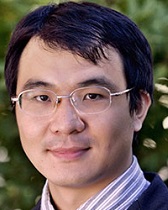
Han Liu
Orrington Lunt Professor of Computer Science and Professor of Statistics
- hanliu@northwestern.edu
- 2233 Tech Drive, Mudd Room 3119
Han Liu develops the foundations and systems of scientific intelligence, connecting reasoning agents, scientific world models, and autonomous laboratories. He is the Orrington Lunt Professor of Computer Science and Professor of Statistics at Northwestern University, where he directs MAGICS Lab and the Center for Foundation Models and Generative AI. His research asks how AI can turn scientific experience into better models of the world and better decisions about what to investigate next.
With students and collaborators, Liu has developed genome foundation models including DNABERT, DNABERT-2, and GenomeOcean, and contributed to SciSciGPT, a research-agent collaboration published in Nature Computational Science. He is a co-principal investigator of DREAM, an NSF-supported $20 million initiative developing a national cloud laboratory for protein engineering. Together, these efforts connect learning and reasoning with experimental evidence.
His work builds on a foundation in statistical machine learning, high-dimensional inference, graphical models, and optimization. Before Northwestern, he held faculty appointments at Princeton University and Johns Hopkins University and directed the deep reinforcement learning center at Tencent AI Lab. He earned a joint PhD in Machine Learning and Statistics from Carnegie Mellon University. His honors include the Presidential Early Career Award for Scientists and Engineers and an Alfred P. Sloan Research Fellowship in Mathematics.
Research Interests
Liu’s research centers on a fundamental question: how can AI learn from the process of scientific discovery itself? His group connects mathematical foundations with computational and experimental systems, studying how evidence from one investigation can improve the reasoning, models, and decisions that shape the next. The program pursues three connected directions:
Recursive scientific intelligence. The group studies memory, adaptation, in-context computation, and tool use in foundation models, and develops agents that organize evidence and plan investigations. The SciSciGPT collaboration connects this agenda to human–AI research workflows in the science of science.
Scientific world models. The group develops representations of biological and physical systems and investigates how they can support prediction, uncertainty quantification, and reasoning about interventions. DNABERT, DNABERT-2, and GenomeOcean ground this agenda in genomic representation learning and sequence generation.
Autonomous laboratories. The group develops methods for connecting AI-guided design, simulation, and automated experimentation in Design–Build–Test–Learn cycles. PEV explores how measured protein outcomes can guide subsequent design decisions. As a co-principal investigator of DREAM, Liu helps develop an NSF-supported $20 million cloud-laboratory initiative for protein engineering.
Together, these directions connect hypothesis formation, predictive modeling, and experimental feedback. The long-term goal is scientific AI that accumulates knowledge and improves how it investigates new questions.
Research program: https://magics.cs.northwestern.edu/research.html
Publications: https://magics.cs.northwestern.edu/papers.html
Open-source systems: https://magics.cs.northwestern.edu/software.html
Selected Publications
Erzhuo Shao, Yifang Wang, Yifan Qian, Zhenyu Pan, Han Liu, Dashun Wang. “SciSciGPT: advancing human–AI collaboration in the science of science.” Nature Computational Science 6: 301–315 (2026).
https://www.nature.com/articles/s43588-025-00906-6
Jerry Yao-Chieh Hu, Hude Liu, Jennifer Yuntong Zhang, HanLiu. “In-Context Algorithm Emulation in Fixed-Weight Transformers.” International Conference on Learning Representations (ICLR) (2026). https://proceedings.iclr.cc/paper_files/paper/2026/hash/0d18ab3b5fabfa6fe47c62e711af02f0-Abstract-Conference.html
Yibo Wen, Chenwei Xu, Jerry Yao-Chieh Hu, Kaize Ding, HanLiu. “Pareto-Optimal Energy Alignment for Designing Nature-Like Antibodies.” Advances in Neural Information Processing Systems 38 (2025). https://papers.nips.cc/paper_files/paper/2025/hash/41f994cacb08c9d2efc9340117e454f0-Abstract-Conference.html
Weimin Wu, Teng-Yun Hsiao, Jerry Yao-Chieh Hu, Wenxin Zhang, HanLiu. “In-Context Learning as Conditioned Associative Memory Retrieval.” Proceedings of the 42nd International Conference on Machine Learning 267: 67300–67325 (2025). https://proceedings.mlr.press/v267/wu25k.html
Zhihan Zhou, Yanrong Ji, Weijian Li, Pratik Dutta, Ramana Davuluri, HanLiu. “DNABERT-2: Efficient Foundation Model and Benchmark For Multi-Species Genomes.” International Conference on Learning Representations (ICLR) (2024). https://proceedings.iclr.cc/paper_files/paper/2024/hash/b633e7052970b8f5aa1a69164d99e9e8-Abstract-Conference.html
Yanrong Ji, Zhihan Zhou, HanLiu, Ramana V. Davuluri. “DNABERT: pre-trained Bidirectional Encoder Representations from Transformers model for DNA-language in genome.” Bioinformatics 37(15): 2112–2120 (2021). https://academic.oup.com/bioinformatics/article/37/15/2112/6128680
Han Liu, John Lafferty, Larry Wasserman. “The Nonparanormal: Semiparametric Estimation of High Dimensional Undirected Graphs.” Journal of Machine Learning Research 10: 2295–2328 (2009). https://www.jmlr.org/papers/v10/liu09a.htm
Full publication list: https://magics.cs.northwestern.edu/papers.html